Invoice OCR Technical Comparison: Laiye ADP vs. Veryfi vs. Google Document AI
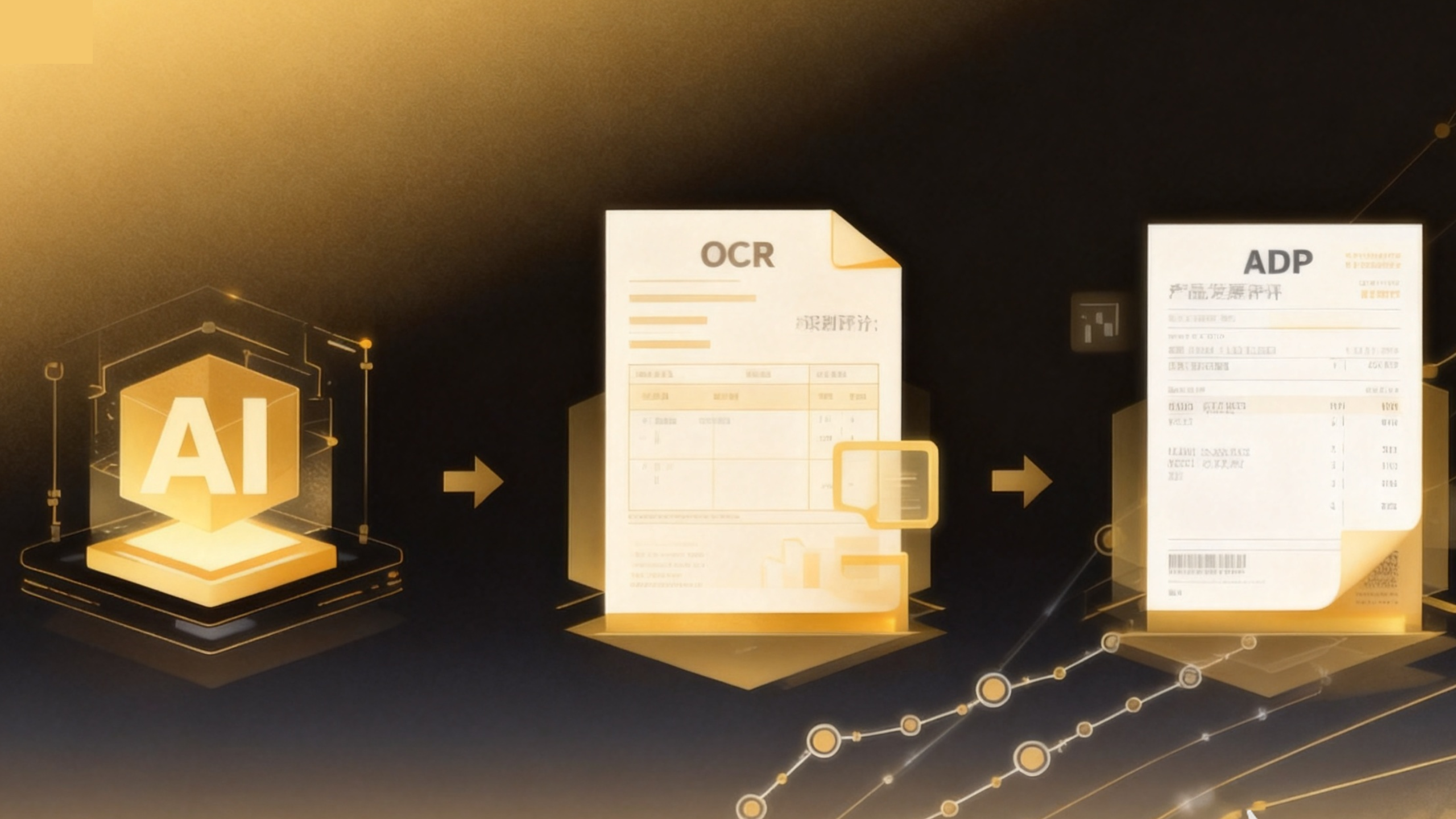
Invoice processing in a globalized context faces challenges such as multilingual text, non-standard layouts, and complex backgrounds (e.g., creases, shadows). The market has shifted from traditional “template-driven” approaches to “understanding-driven” and “multimodal AI” architectures. This article provides a neutral, side‑by‑side comparison of three mainstream solutions across four dimensions: technical architecture, real‑world performance, scenario fit, and cost, helping enterprises choose based on their specific business needs.
Overview of Next‑Gen OCR approaches
Vertical AI (e.g., Veryfi) relies on a multimodal foundation model combined with deterministic algorithms. It is template‑free, integrates computer vision and NLP for real‑time processing, and excels in ultra‑fast response, fraud detection, and high accuracy on mature Western markets. Integration is via API/SDK.
Agentic understanding‑driven solutions (e.g., Laiye ADP) use a vision‑language model plus a large language model and agent architecture. They deeply integrate AI capabilities, emphasize cross‑lingual generalization and self‑learning, and are ideal for non‑standard, multilingual invoices — especially in global emerging markets. Integration options include API, CLI, SKILL, and the agent ecosystem.
Cloud hyperscaler solutions (e.g., Google Document AI) combine LayoutLM/LiLT with LLM augmentation, deeply fusing text, layout, and image features while supporting few‑shot extraction. They are best suited for standard invoice processing within the Google Cloud ecosystem. Integration is via API/SDK plus Google Cloud services.
None of these approaches is absolutely superior. Vertical AI excels in accuracy and speed for well‑defined scenarios. Agentic understanding‑driven solutions shine in global, non‑standard invoice adaptation and integration with agent ecosystems. Cloud hyperscaler solutions offer the lowest integration cost within their own ecosystems.
Strengths and limitations of each solution
Veryfi
Veryfi’s core strength lies in its proprietary multimodal foundation model. On standard English invoices from North America and Europe, it delivers very high accuracy with typical response times of 3–5 seconds. However, its coverage depends on the breadth of its training data, which is early training focused on Western markets. As a result, specialized Asian invoice formats (e.g., certain VAT invoices) may require additional localization tuning.
Google Document AI
Google Document AI offers the lowest integration cost for users already within the Google Cloud ecosystem (BigQuery, GCS), but it provides limited out‑of‑the‑box fields. Non‑standard business fields require custom extractors to be configured and trained.
Laiye ADP
Laiye ADP is built on a vision‑language model architecture, enabling strong understanding and generalization in non‑standard, multilingual scenarios, with typical response times of 3–6 seconds. It covers over 100 languages globally, including Chinese, English, Thai, Spanish, Korean, German, Dutch, and more. Its agent architecture enables a data‑flywheel: human corrections feed back to improve the model, and the system autonomously adapts to new layouts and fields over time. It supports both public cloud and on‑premises deployment.
Laiye has been named a Gartner Magic Quadrant Leader for Robotic Process Automation (RPA) for five consecutive years, and is also recognized by Gartner in both the Intelligent Document Processing (IDP) and Enterprise Conversational AI Platforms Magic Quadrants. This recognition validates its technology leadership in document intelligence.
In short: there's no "best" solution. Only the one best suited to your specific scenario. The key questions are: where do your invoices come from? How standardized are they? How many fields do you need?
Real-world multilingual benchmark: three solutions compared
Evaluation data
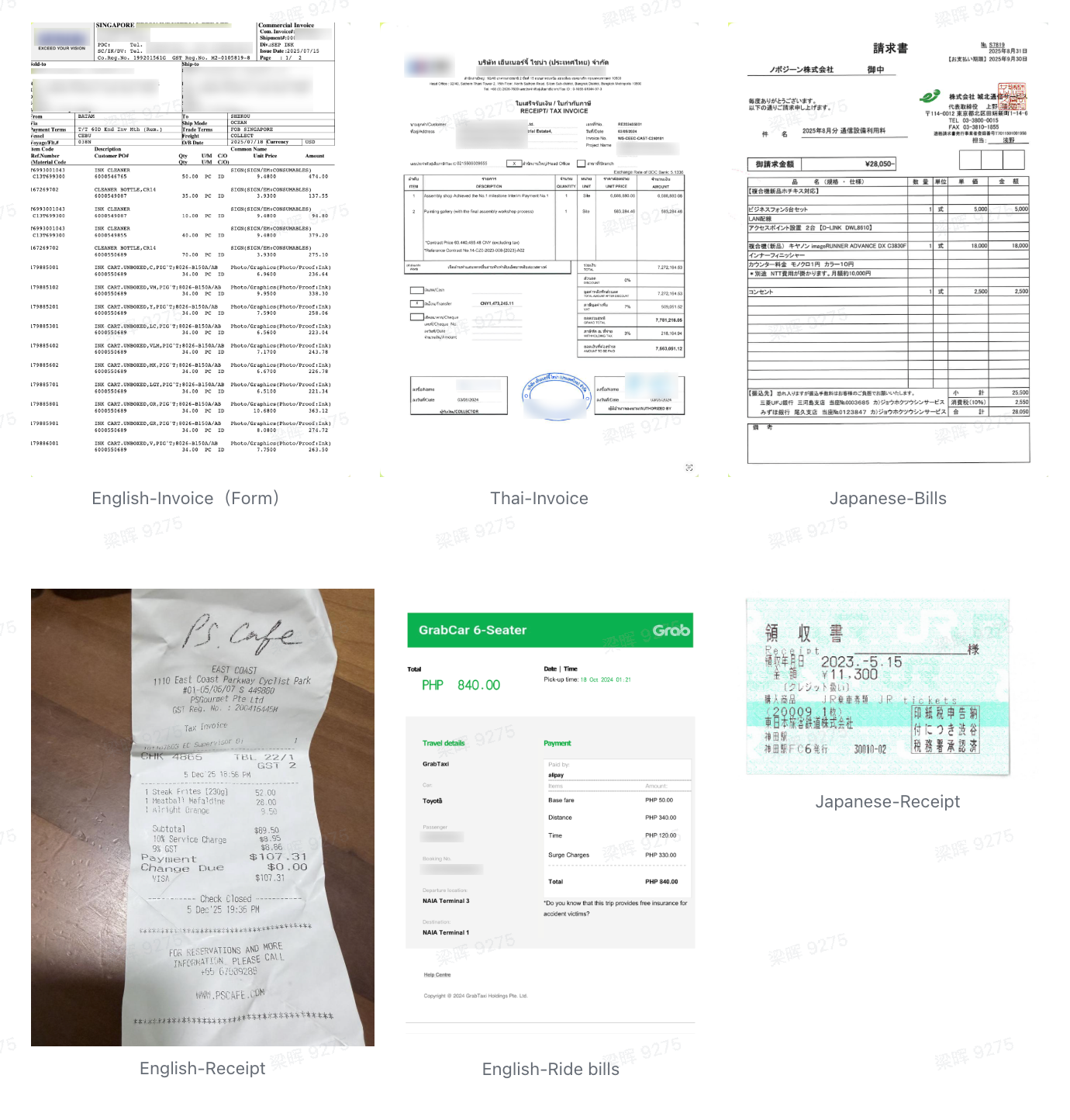
- Sample set: 394 real invoices (657 pages) from global regions
- Countries: 26 countries, covering Chinese, English, Thai, Spanish, Korean, German, Dutch, Japanese, Vietnamese, Turkish, French, Arabic, and others
- Formats: VAT Invoice, Tax Invoice, Commercial Invoice, Receipt, 領収書 (Japanese), and others
- Quality: Standard templates, scanned documents, PDFs, mixed‑layout documents (excluding handwritten annotations or severely blurred documents)
- Fields: 32 business fields in total (amount fields, line items, tax fields, customer information)
Evaluation metrics
Three core metrics:
- End‑to‑end latency: time from API request to full response.
- Field‑level accuracy: measured separately for full fields and key business fields (date, invoice number, amount, etc.).
- Cost per invoice: total processing cost including API calls and infrastructure.
Benchmark
Veryfi
- Average response time: 7.06 seconds per file (4.23 seconds per page)
- Full‑field accuracy: 58.45%
- Key‑field accuracy: 74.03%
- Cost per invoice: $0.045
Key strengths: Fraud detection engine, mature ecosystem (mobile SDK, WhatsApp bot)
Google Document AI
- Average response time: 31.99 seconds per file (19.18 seconds per page)
- Full‑field accuracy: 77.35%
- Key‑field accuracy: 87.89%
- Cost per invoice: $0.032
Key strengths: Seamless Google Cloud integration, cloud‑native scalability
Laiye ADP
- Average response time: 8.83 seconds per file (5.29 seconds per page)
- Full‑field accuracy: 90.34%
- Key‑field accuracy: 98.32%
- Cost per invoice: $0.030
Key strengths: Understanding‑driven architecture, cross‑lingual generalization, region‑specific tax parsing, agent self‑evolution, on‑premises deployment support
How to choose: scenario fit is more important than numbers
Choose a vertical AI solution (e.g., Veryfi) if:
- You have extremely strict real‑time response requirements (Veryfi: 4.23 seconds per page vs. Laiye ADP: 5.29 seconds per page).
- Fraud detection is a key requirement.
Expected outcome: 98%+ key‑field accuracy on Western invoices, with 3–5 second response times.
Choose an agentic understanding‑driven solution (e.g., ADP) if:
- Your invoices come from around the globe, with new vendors, regions, and layouts constantly emerging.
- Invoice formats are diverse and fragmented — including handwritten items, scanned documents, and mixed layouts.
- Agent products like OpenClaw or WorkBuddy can directly call ADP Skills.
Expected outcome: 98%+ key‑field accuracy out‑of‑the‑box, with autonomous agent optimization that improves over time.
Choose a cloud hyperscaler solution (e.g., Google Document AI) if:
- You are deeply invested in the Google Cloud ecosystem and need seamless integration.
- Your invoices are mostly standard formats, and you are willing to invest implementation effort for non‑standard cases.
Expected outcome: Lowest integration cost within the Google Cloud ecosystem, but non‑standard fields require custom configuration and training.
Total cost of Ownership
Total cost = API calls + integration development + custom training + template maintenance + human review
Veryfi
- API call cost: $0.045
- Integration development cost: low (mature API/SDK)
- Pre‑built fields: 100+
- Field extension cost: high (requires vendor support)
- Human review cost: medium (low in North America and Western Europe)
Estimated annual cost for 100,000 pages: $5,800 – $6,500
Google Document AI
- API call cost: $0.032
- Integration development cost: medium (API/SDK + Google Cloud ecosystem setup)
- Pre‑built fields: 20
- Field extension cost: high (requires labeling and training)
- Human review cost: medium
Estimated annual cost for 100,000 pages: $5,200 – $6,000
Laiye ADP
- API call cost: $0.030 per invoice
- Integration development cost: low (API/CLI/SKILL + agent ecosystem)
- Pre‑built fields: 32
- Field extension cost: low (customizable, agent self‑optimizes)
- Human review cost: low (98%+ accuracy for multilingual invoices)
Estimated annual cost for 100,000 pages: $3,500–4,200
Selection Advice
- Validate with your own data: Running 100 of your actual invoices through each solution is far more telling than any benchmark.
- Estimate next year’s expansion cost: Instead of asking "What can it handle today?", ask "What happens when you add a supplier next year?"
Conclusion
The core value of an agentic understanding‑driven solution: one API that covers invoices from 100+ countries, 32 business fields, and multiple layouts — out‑of‑the‑box, with no template configuration or model training.
For companies going global with increasingly diverse invoice sources, choosing an understanding‑driven solution means:
- ✅ No more dedicated development for each new region or format.
- ✅ No more maintaining a massive template library.
- ✅ No more worrying that invoices from a certain region will be “unrecognizable.”
Sign up for 1,000 free pages. Test with your own invoices today: https://adp-global.laiye.com/
Frequently Asked Questions (FAQ)
Q1: Isn’t this benchmark from Laiye ADP biased?
A: The data comes from Laiye ADP’s internal validation. We encourage every enterprise to run the same test with their own 100 real invoices using each vendor’s free trial or pay‑as‑you‑go API. No third‑party benchmark can replace your own data.
Q2: What does “out‑of‑the‑box” mean for ADP? Can I really use it without any training?
A: Yes. ADP uses a vision‑language model and large language model architecture. You simply describe the fields you need in natural language (e.g., “extract invoice number, total amount, and tax”), and the system works immediately on a new layout or language – no template configuration or sample labeling required.
Q3: How reliable is ADP’s 98.32% key‑field accuracy?
A: That number comes from the benchmark test on 394 real invoices covering 26 countries. In production, key‑field accuracy for multilingual invoices is consistently above 98% based on internal validation. Accuracy may vary depending on document quality and field definitions, which is why we offer a free 1,000‑page trial for you to test with your own documents.
Q4: Can ADP be deployed on‑premises? What about data privacy?
A: Yes, ADP supports fully on‑premises deployment. All models and data stay within your own infrastructure – data never leaves your environment. Transmission is TLS‑encrypted, access is RBAC‑controlled, and all operations are auditable.
Q5: Does ADP work for invoices in Japanese, Arabic, or Thai?
A: Yes. ADP covers over 100 languages, including Japanese, Arabic, Thai, Vietnamese, Turkish, French, German, Dutch, Spanish, Korean, and Simplified/Traditional Chinese. Mixed‑language documents are also supported.
This article focuses on technical architecture analysis. Test data is sourced from Laiye ADP internal validation. Each solution performs excellently in its home‑court scenario — we recommend validating with your own business documents.