
From RPA to APA: How Agentic Process Automation Transforms Enterprise Financial Reconciliation
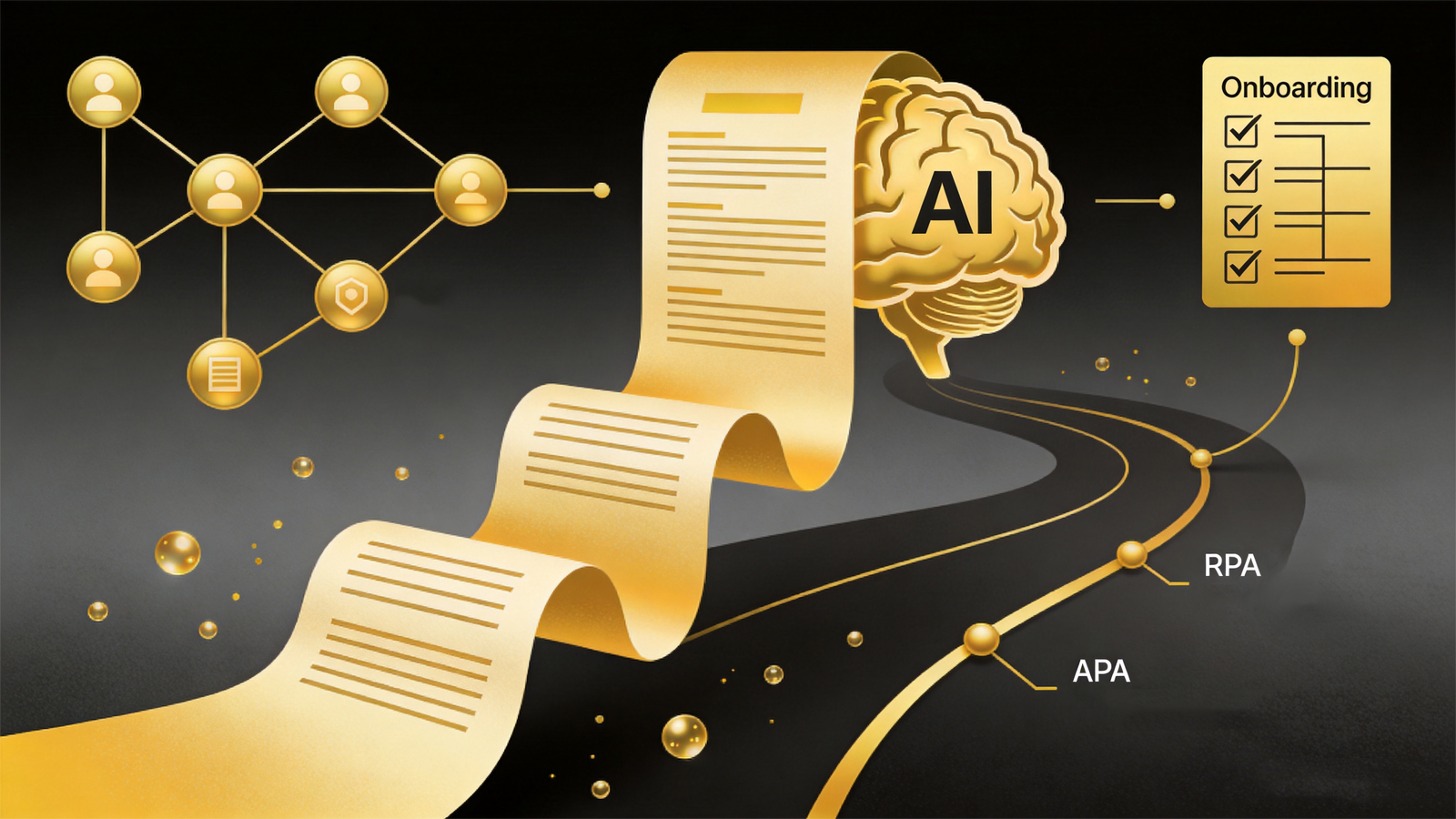
RPA financial reconciliation is the use of software robots to automatically match financial records across bank accounts, vendor systems, and internal ERPs, replacing manual, transaction-by-transaction comparison with 24/7 automated execution, achieving 95-100% accuracy while reducing reconciliation labor by 80% or more.
Financial services account for the largest share of enterprise RPA deployments, driven overwhelmingly by reconciliation and reporting use cases.
What is RPA financial reconciliation?
RPA financial reconciliation uses Robotic Process Automation (RPA) technology to automatically complete account matching between a company’s finance department and banks, suppliers, and internal systems. Traditional manual reconciliation is time‑consuming and error‑prone. RPA reconciliation bots can run 24/7, automatically logging into online banking portals, downloading statements, extracting key information, intelligently matching data against ERP/financial systems, and generating variance reports.
Beyond traditional RPA: APA + ADP
Traditional RPA works well when everything is predictable — fixed statement formats, stable banking portals, clean digital data. But real-world finance departments deal with scanned PDFs, handwritten remittance notes, vendor emails in different layouts, and banking portals that change their interfaces without notice.
- APA (Agentic Process Automation) is the next evolution of RPA. Instead of rigid, rule-based bots that break when anything changes, APA uses AI agents that can adapt to interface changes, handle exceptions, and learn from corrections. It's not a separate technology, it's what RPA becomes when you add intelligence.
- ADP (Agentic Document Processing) is Laiye's document intelligence product, designed to natively integrate with APA. It handles what traditional RPA never could: reading unstructured PDFs, scanned bank statements, handwritten invoices, and vendor documents in any layout, using semantic understanding rather than fixed-position rules. Format changes don't require redevelopment.
Together, APA + ADP handle the full spectrum: from clean digital data to the messiest real-world documents, all automated end to end. Laiye is recognized by Gartner across the RPA, IDP, and Conversational AI Magic Quadrants and has been listed in the RPA Magic Quadrant for five consecutive years.
Major scenarios of Financial Reconciliation
- Bank Reconciliation Automation
Large enterprises typically manage dozens of bank accounts across multiple financial institutions. Each month, every account requires reconciliation, downloading statements, matching transactions against ERP postings, and investigating discrepancies.
How it works:
- Bots log into each banking portal automatically, supporting multiple authentication protocols
- Electronic statements are downloaded in any format, PDF, Excel, XML, image
- ADP technology extracts key fields: transaction amounts, dates, reference numbers
- Unmatched items are flagged in a structured variance report for review
Results:
- Processing speed: 5-36x faster, what took hours now takes minutes
- Throughput: 20,000+ transactions processed monthly per bot cluster
- Accuracy: 95-100%, eliminating manual keystroke errors
- Labor reduction: 80%+ decrease in reconciliation staffing requirements
- Vendor Account Reconciliation
Accounts payable teams reconcile statements from hundreds of vendors every month. These statements arrive in disparate formats, some as PDFs, others as Excel spreadsheets, still others as scanned documents. Finance staff manually extract data and perform three-way matching against purchase orders, goods receipt records, and invoices.
How it works:
- ADP automatically reads vendor statements regardless of format or layout variation
- Key fields, vendor name, reconciliation period, amounts, line items, are extracted instantly
- The system performs automated three-way matching against PO, receipt, and invoice data in ERP
- Discrepancies are flagged: amount mismatches, missing invoices, duplicate payment
Results:
- Document processing: 30 minutes reduced to 20 seconds
- Document handling efficiency: 90%+ improvement
- Manual audit workload: 85% reduction
- Intercompany Reconciliation
Group enterprises face a unique challenge: each subsidiary may run different ERP systems, yet every entity must reconcile with every other entity each month. Data formats never align naturally, and the manual effort required grows exponentially with the number of entities.
How it works:
- APA logs into each subsidiary's system, adapting to interface differences autonomously
- Field mappings across systems are resolved automatically through semantic understanding
- Variance analysis identifies root causes: timing differences, exchange rate fluctuations, in-transit items
- Variance reports are pushed to the appropriate parties for confirmation via collaborative workflow
Results:
- Preparation time: 3 days reduced to 2 hours
- Filing accuracy: approaching 100%
- Compliance risk: significantly reduced
Proven enterprise results
Case 1: Global Manufacturing Leader
A Fortune 500 manufacturing company deployed 15 finance robots across 44 automated processes covering cost accounting, sales reconciliation, and procurement matching.
Annual savings exceeded $250,000. More than 20,000 labor hours were returned to the finance team. Process accuracy reached 100%. The deployment also eliminated over 20,000 kg of CO₂ emissions by reducing system runtime.
"We started with real operational problems rather than technology for its own sake. The ROI spoke for itself, and our teams experienced the benefits firsthand.",
—— VP of Engineering
Case 2: Multinational Financial Services Firm
A top-20 global bank automated 100+ finance processes across operations in 50+ countries, serving 50,000+ employees. Reconciliation efficiency improved 5x. Monthly savings exceeded 900 labor hours. Accuracy stabilized at 95% and improved over time as the system learned from exception-handling patterns.
Case 3: Leading Investment Bank
A major investment bank deployed RPA for compliance verification and regulatory reporting in high-frequency trading environments. Where data accuracy is non-negotiable and regulator deadlines are fixed, automation eliminates manual reconciliation delays and reduces filing errors to near zero.
FAQ
Q1: How does RPA financial reconciliation compare to manual reconciliation?
A: Three measurable advantages: processing speed improves 5-36x; accuracy reaches 95-100% compared to typical human error rates of 2-5% in high-volume data entry; and labor costs decrease by 80% or more, delivering ROI within the first quarter of deployment.
Q2: How is data security handled?
A: Enterprise-grade security is built in: complete audit trails with full traceability, role-based access control with granular data permissions, optional on-premise deployment for organizations with strict data residency requirements, and compliance with ISO 27001, SOC 2 Type II, and equivalent security frameworks.
Q3: Can RPA handle frequently changing statement formats?
A: Traditional RPA breaks when formats change. ADP (Agentic Document Processing) uses semantic understanding rather than fixed-position rules — it reads the content regardless of layout, so format changes do not require redevelopment.
Q4: How quickly can we deploy?
A: Simple reconciliation scenarios go live in 2-4 days. Complex multi-system deployments take 1-2 weeks. This represents a 50%+ reduction compared to traditional RPA implementation cycles.
Q5: What is the difference between traditional RPA and Laiye APA?
A: Traditional RPA uses fixed, rule-based scripts. When a banking portal changes its layout or a statement arrives in a new format, the bot breaks and requires manual repair. Laiye APA adapts to UI changes automatically, and autonomously resolves many exceptions. The result: maintenance costs drop by ~80%, and processes that were too brittle to automate become viable.
Q6: Does this solution require changes to our existing ERP or banking systems?
A: No. Laiye APA works at the user interface level, it logs in and operates systems just like a human would, using screen scraping. No modifications to SAP, Oracle, NetSuite, or banking portals are required. Deployment is non-invasive and can be rolled back at any time.
Q7: Can we start with a small pilot and scale later?
A: Yes. Most customers begin with 1-2 high-volume bank accounts or a handful of key suppliers. Once the pilot validates ROI (typically within 1-2 months), you can expand to more accounts, add intercompany reconciliation, and eventually integrate ADP for document-heavy workflows. Laiye APA scales from a single bot to hundreds without platform changes.
Q8: Does Laiye support on‑premise deployment for regulated industries?
A: Yes. Laiye APA can be deployed entirely on‑premise or in a private cloud. Data never leaves your environment. The platform supports role-based access control, full audit logging, and meets requirements for ISO 27001, SOC 2, and financial industry regulations (e.g., PCI-DSS where applicable).

