
Laiye APA Enterprise Edition Release: Making Automation Processes True Enterprise Assets

Today, Laiye has released APA (Agentic Process Automation) Enterprise Edition. This release fundamentally changes how automation processes exist, turning them into enterprise assets that can be continuously built, evolved, and applied at scale.
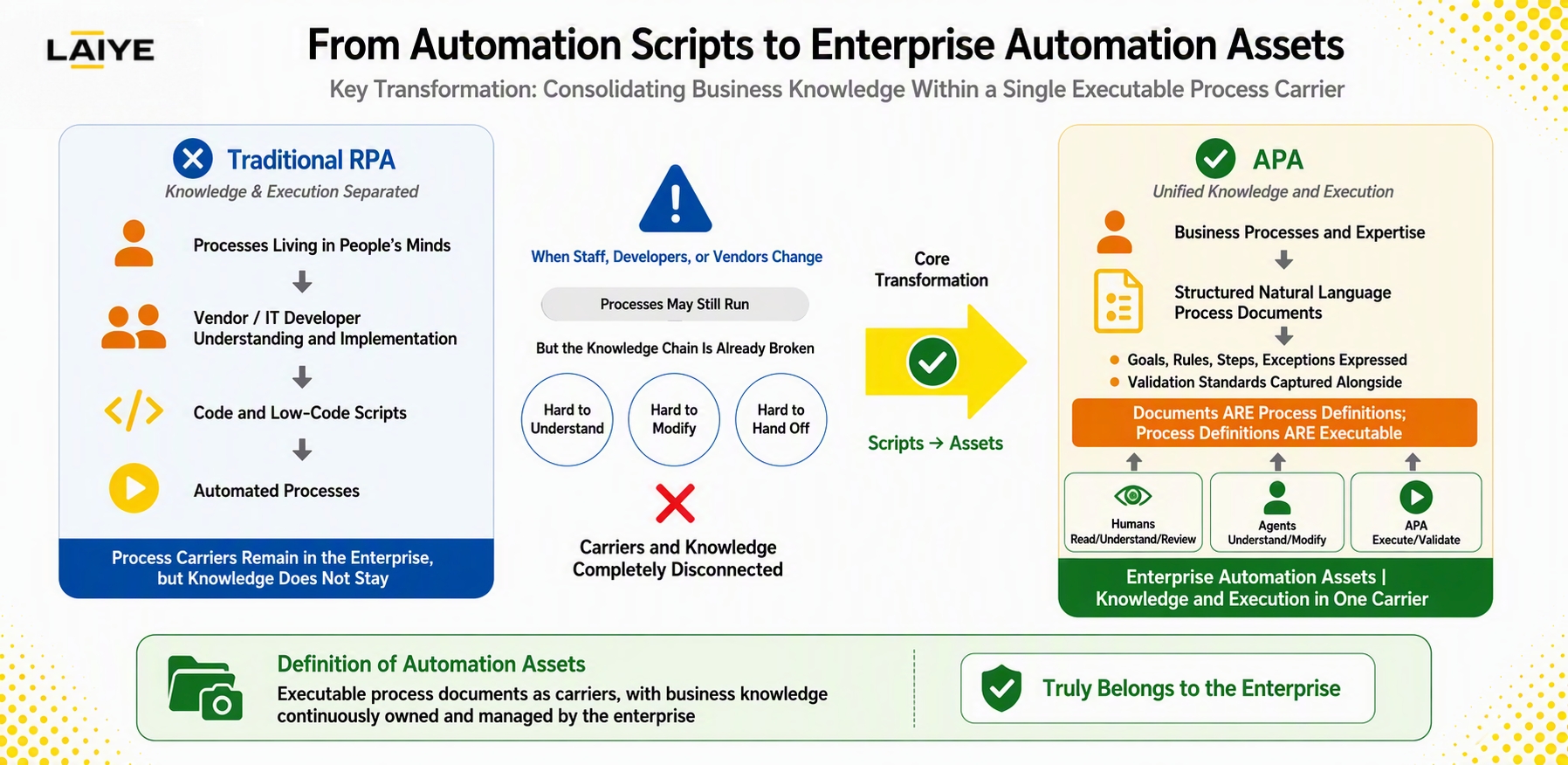
APA distills business knowledge and execution capability into a single executable natural-language process document. This document isn't a side note to the process but it is the execution definition itself. One document serves as both the process definition and the executable process itself.
Three pillars make process becoming assets
Built around the executable process document as its single unified foundation, Laiye APA covers the full lifecycle of a process asset from creation to growth to reuse.
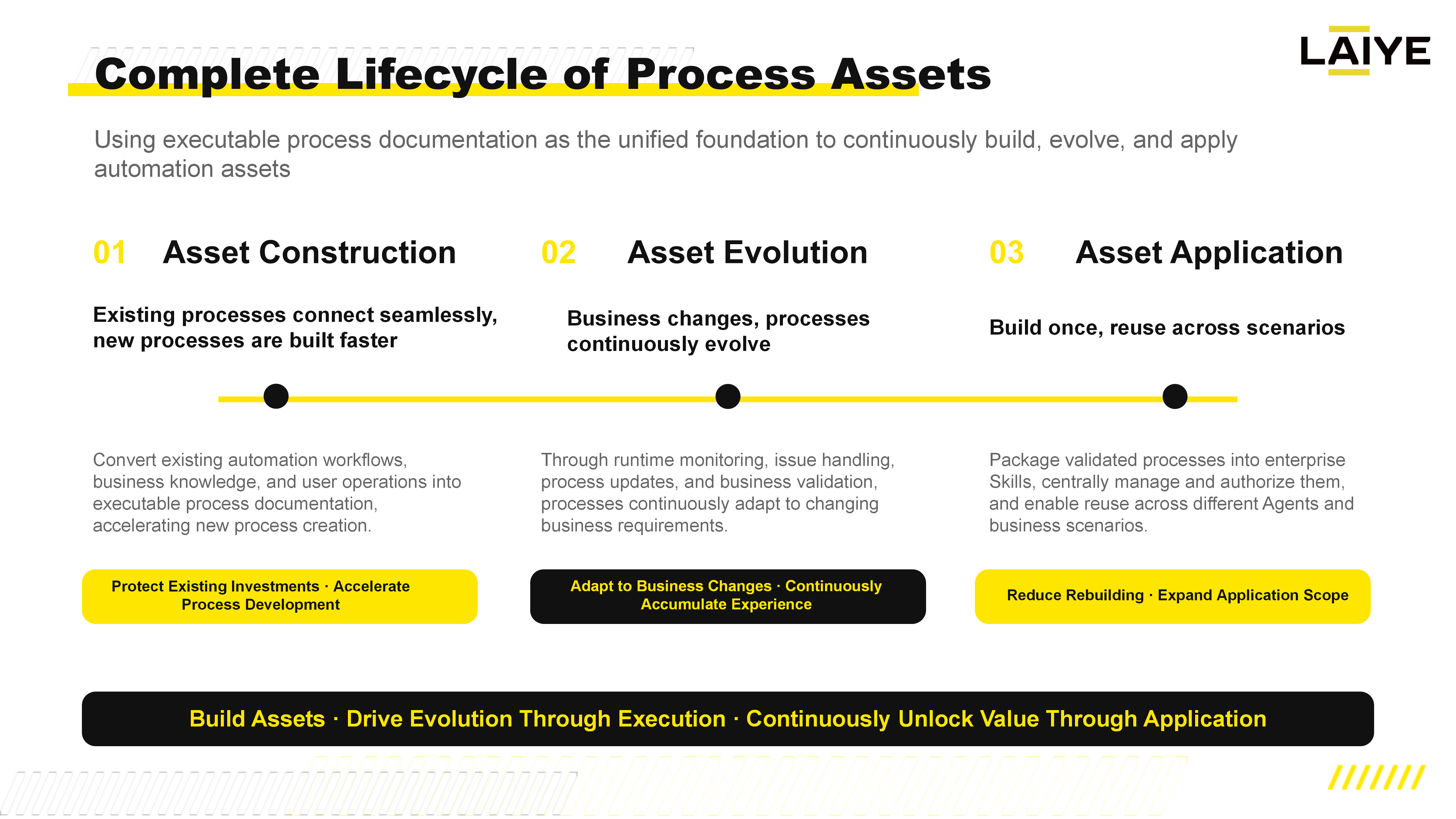
1. Asset building: take over existing processes, build new ones fast
Keep using existing processes: Laiye APA supports importing existing Laiye RPA processes (compatible operation, or code-to-code migration). RPA processes from other vendors can be rebuilt into knowledge based on existing requirement documents or code understanding, then reimplemented after business confirmation. After migration, processes go through debugging, testing, and regression verification to ensure reliability.
New processes don't start from scratch: With AI-assisted generation and operation recording, business users describe requirements in natural language, the AI builds the process, and people focus mainly on decisions.
2. Asset evolution: when the business changes, the process changes with it
In the past, process changes had to travel a long chain: business raises requirements → IT interprets them → developers make changes → repeated verification. Business users could hardly participate directly, making evolution high-barrier and slow.
APA changes this:
- Self-healing: When page elements change or safely identifiable blocking popups appear, APA heals itself automatically to keep execution running.
- Business users participate directly: They can read the natural-language process document, describe changes, review AI modifications, and confirm business outcomes.
- Knowledge retention: Exception handling, fix experience, and verification results all flow back into the process asset.
3. Asset application: build once, reuse everywhere
APA packages completed processes into standardized, reusable, and governable enterprise skills, registered, managed, and authorized centrally in the Digital Workforce Platform.
A single process capability can be:
- Invoked by agent products such as Laiye Worker
- Returned as clear, verifiable, and traceable results via CLI + Skill
- Used across products, teams, and scenarios
Case Study: Employee expense reimbursement process
What difference does APA make compared to traditional RPA on the same process?
In a real test on an employee expense reimbursement demo, a product manager with 5 years of RPA experience needed roughly 2 hours to develop it by hand with traditional RPA. For the same scenario, APA took about 5 minutes to record requirements and about 10 minutes for AI generation and it ran successfully on the first attempt.
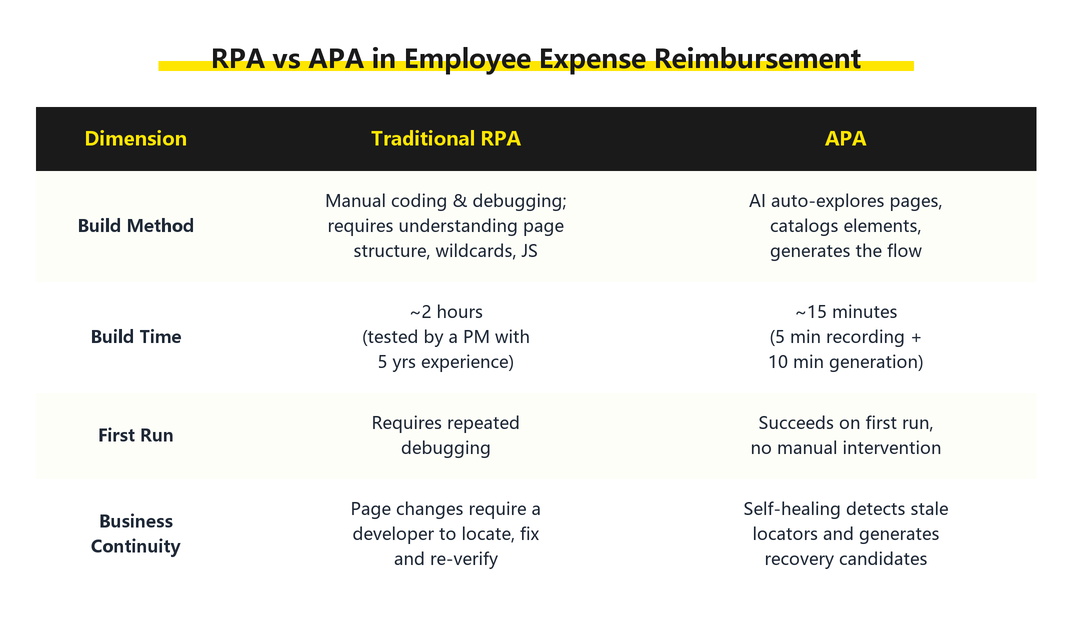
The point here isn't expense reimbursement itself. It's that any high-value, clearly-ruled, continuously-changing enterprise process can be turned into an asset with APA.
Availability
Laiye APA Enterprise Edition is now available.
Contact Sales for APA Enterprise Edition.


