
Laiye Ranked #1 in China's APA Product Market Share


International Data Corporation (IDC) recently released China APA Products and Solutions Market Shares, 2025: Agents Accelerate Process Automation Adoption, Digital Workforce Emerges as a New Application Form (Doc #CHC54084926). This marks IDC's first-ever quantitative study of China's Agentic Process Automation (APA) market, signaling APA's formal entry into authoritative market research as the next-generation enterprise process automation paradigm.
According to the report, APA's core positioning is a governable platform layer that sits between enterprise RPA, workflow and rules engines, and agents. On one hand, it encapsulates APIs, scripts, and processes into tools and Skills that agents can leverage. On the other, it helps enterprises build and maintain these critical intelligent assets more efficiently. For enterprises, APA delivers far more than process efficiency gains, its greater importance lies in making automated processes true enterprise assets.
Authoritative Validation: #1 in APA Product Market Share
IDC data shows that China's APA products and solutions market reached approximately RMB 2.15 billion in 2025 (around 300 million USD). As the pioneer of the APA concept and paradigm, Laiye holds a 10.8% market share of the APA product, ranking #1 in China's APA product market.
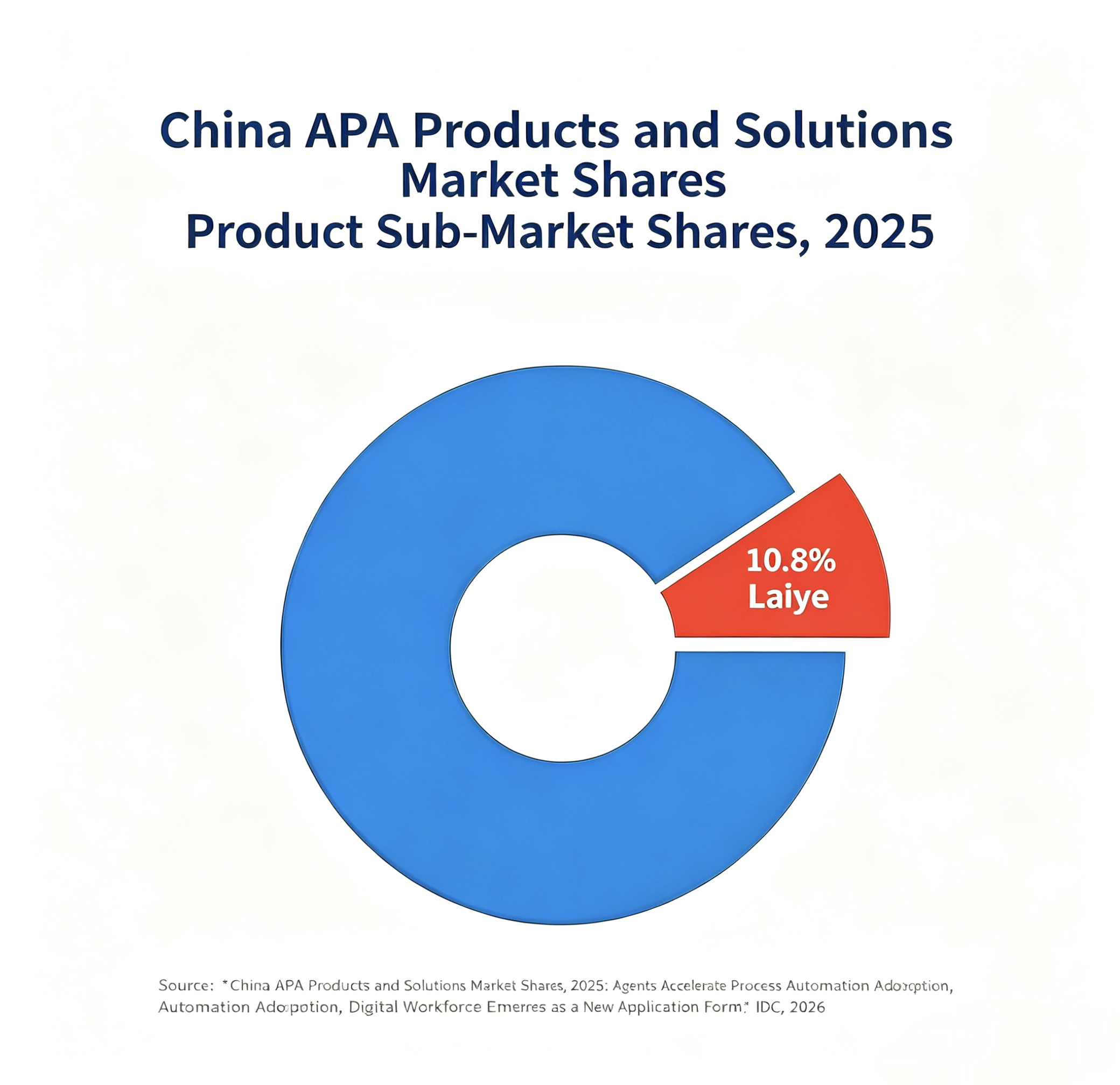
IDC research notes that leading vendors maintained their edge during the early market transition because of their extensive RPA heritage. As agentic capabilities entered the landscape, existing product strengths and industry project experience became foundational assets for APA platforms. Laiye exemplifies this trajectory: its long-standing deterministic execution capabilities, enterprise-grade governance expertise, and cross-industry automation practices have been systematically restructured into the core foundation of its APA platform.
Laiye's Agentic Digital Worker Platform is built on a comprehensive capability architecture spanning APA (Agentic Process Automation), ADP (Agentic Document Processing), and ACX (Agentic Customer Experience). It standardizes and delivers document understanding, natural language interaction, RPA execution, and Skills capabilities, empowering enterprises with end-to-end intelligent automation task execution.
APA: A Paradigm Shift in Enterprise Process Automation
The emergence of the APA market represents both a restructuring of enterprise automation systems in the agentic era and a paradigm upgrade, transforming automated processes from one-time deliverables into enterprise assets. Over the past decade, RPA became a core enterprise digitalization tool through its deterministic execution and low-code advantages. Yet as organizations sought to expand automation from a handful of high-frequency processes to thousands of long-tail processes, purely manual build-and-maintain models hit a scalability ceiling. Meanwhile, the business knowledge and execution logic embedded in these processes remained tied to the individuals who originally built them. When those people moved on, processes risked becoming inscrutable, unmaintainable "automation legacy".
Laiye was among the first to recognize the inevitability of this paradigm shift. In 2025, Laiye launched APA community version, completing its strategic repositioning from RPA to APA. Building on the proven reliability of RPA's deterministic execution and enterprise-grade governance, APA Creator introduces four core capabilities: agent-driven development, document-based human-machine collaboration, built-in LLM command interfaces, and Computer-use agents, enabling processes with perception, analysis, orchestration, and autonomous execution. The result: tenfold developer scalability and tenfold scenario coverage.
Its core value is making automated processes true enterprise assets: through asset construction, existing processes are maintained and new ones are built rapidly; through asset evolution, business changes are incorporated into workflows in real time, with business users directly participating; through asset application, processes are encapsulated as enterprise Skills, reliably callable by diverse products and agents. APA does not replace RPA, it enhances and extends it, preserving the reliability of stable execution while gaining the agility that agents bring.
IDC's decision to track APA as an independent market for the first time is an industry-level validation of this paradigm upgrade. APA unifies RPA, workflow, scripting, connectors, and business system integration, giving enterprises the ability to build automation systems that adapt to end-to-end tasks with greater flexibility, higher operational efficiency, and practical governance. Within this framework, existing processes and execution capabilities continuously accumulate as process assets, which are further encapsulated as tools and Skills callable by agents.
The next chapter of enterprise process automation has begun. The future of automation is not a trade-off between stability and intelligence. It is about making processes reliably executable, continuously evolvable, and assets that enterprises can own and reuse at scale.